
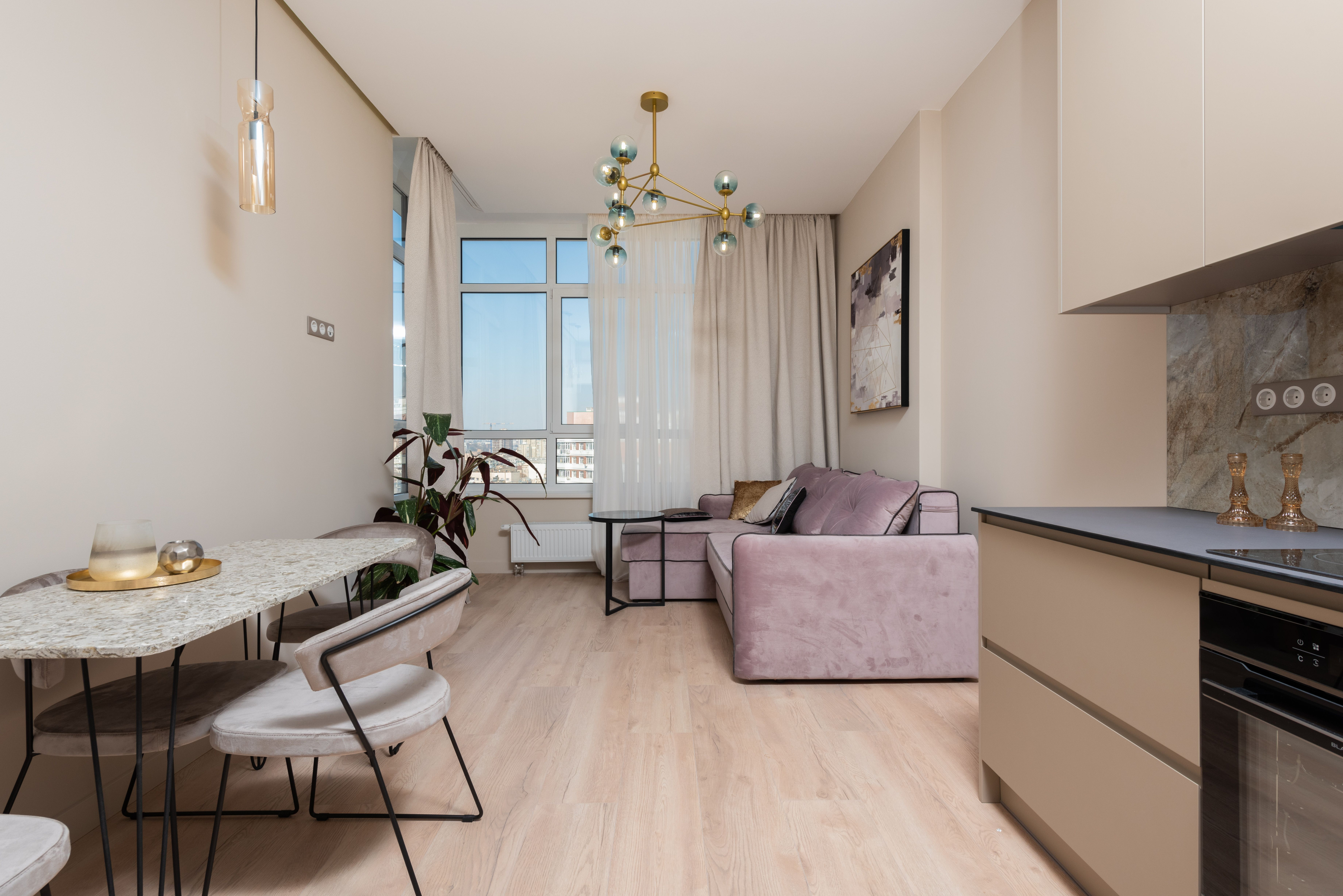
Quick Answer: Figuring out how to make a studio apartment feel like two rooms comes down to one move: separate where you sleep from where you live. Mark that line with a divider, or with furniture and a rug. For renters, a curtain on a tension rod or an anchored open-back bookcase does the job without building a wall.
A studio puts your bed, couch, desk and kitchen in one sightline, so the whole place reads as a single room. Albuquerque renters comparing studios in Uptown and the Northeast Heights can start with our breakdown of how much space a 300 sq ft studio really gives you, then come back for the layout fixes below. Every one of them uses dividers, furniture or light, and every one comes back down on move-out day.
What Does It Mean to Make a Studio Feel Like Two Rooms?
It means giving your studio two zones with different jobs: a private sleeping area and a public living area. The split can be physical, like a curtain, or visual, like a rug and a lamp. The test is simple. A guest should be able to sit down without feeling parked in your bedroom.
Square footage is the constraint. As of May 2026, RentCafe's analysis of Yardi data put the average U.S. studio at 460 square feet against 735 for a one-bedroom. That 275-square-foot gap is what you're faking. Studios were also just 5.2% of apartments built in 2025 in the same data, which is why so much layout advice assumes a bedroom you don't have.
Studio Layout Ideas That Start With the Bed
Place the bed first. Everything else follows it.
The best spot is usually the corner farthest from the front door, so the bed isn't the first thing anyone sees walking in. Run it along a long wall instead of floating it mid-room. Then put your divider, or the back of your sofa, between the bed and the door. A sofa facing away from the bed is the cheapest wall you'll ever build.
Which Room Dividers for Studio Apartments Work Best?
The best room dividers for studio apartments hide the bed while still letting daylight reach both zones. For most renters that means a curtain, a folding screen or an open-back bookcase. Choose by answering two questions: do you need storage, and are you allowed to put holes in the walls or ceiling?
| Divider Type | Best For | Drilling Needed? | Tradeoff |
|---|---|---|---|
| Curtain on a tension pole or ceiling track | Full privacy for the bed at night | Tension pole: no. Ceiling track: yes | Blocks light when closed; keep fabric away from heaters |
| Folding screen | A quick visual break you can move | No | No storage, and it knocks over easily |
| Open-back bookcase | Storage plus a see-through wall | Usually, to anchor it | Tip-over risk if left unanchored |
| Rug, lamps and furniture placement | Narrow studios where a barrier feels cramped | No | Weakest sense of separation |
| Curtain plus a low bookcase | Renters who want two distinct rooms | Minimal | Costs more and uses more floor space |
Studio Apt Dividers That Don't Need Drilling
Tension poles are the renter's friend. A floor-to-ceiling pole holds a curtain without a screw, and it comes down in minutes. Folding screens are simpler still. Check your lease before mounting a ceiling track, because holes overhead can count as damage at move-out.
Heavy fabric has one catch. The U.S. Fire Administration says to keep anything that can burn at least 3 feet from heat sources, space heaters and radiators included. Don't hang a curtain divider next to one, even for a single cold night.
Studio Apartment Room Partitions That Double as Storage
An open-back bookcase is a wall you can use. Books and baskets block the view, and light still slips through the gaps. It's also the riskiest option here. CPSC's 2022 tip-over report counts a room divider among the furniture in its fatality data, and the agency's Anchor It! campaign says furniture with shelves belongs anchored to the wall. A bookcase standing mid-room has no wall behind it, so pick a low, wide unit, keep heavy items on the bottom shelves and anchor one end to a side wall. Ask your leasing office before drilling, and get the answer in writing.
How Can Furniture and Lighting Split a Studio Without a Wall?
Furniture and lighting split a studio by telling your eye where one zone ends. A rug under the sofa defines the living room. A different light over the bed defines the bedroom. Nothing blocks the view, so this approach works best in long, narrow studios where a physical divider would turn the space into a hallway.
Studio Flat Furniture Ideas That Create Zones
Search for studio flat furniture ideas and you'll land on British small-space tricks that work fine in American apartments. A sofa with a finished back floats in the room as a half-wall. Put a narrow console table behind it and you have a landing spot for keys and mail. A daybed works as a couch by day and a bed by night, which removes the bedroom problem altogether. Want the sleep side private without losing your window? Face the desk and sofa toward the living zone so nobody's gaze lands on the bed.
Room Separators for Studio Apartments Made of Light
Light is the cheapest of the room separators for studio apartments. Give each zone its own lamp and switch them independently: a warm bedside lamp for sleeping, brighter floor or overhead light for the living side. The Department of Energy says residential LEDs use at least 75% less energy and last up to 25 times longer than incandescent bulbs, so a second or third lamp costs little to run. In a sunny city like Albuquerque, sheer curtains are also worth a look, since they let window light reach the far side of the room.
Frequently Asked Questions
1. Do dividers for studio apts make the space look smaller?
Solid, full-height dividers can make a studio look smaller because they cut the sightline. Open-back shelves, sheer curtains and dividers that stop short of the ceiling avoid that. The goal is to hide the bed from the entry and the sofa, not to box it in. If the room starts to feel like a hallway, go lower or lighter.
2. How do you divide a studio apartment without drilling?
You have more options than most renters expect:
- A floor-to-ceiling tension pole with a curtain
- A freestanding folding screen
- A sofa or daybed placed as a half-wall
- A large rug that marks the living zone
- Separate lamps for the sleep and living areas
3. Can I build a wall in my studio apartment?
Only with written permission from your landlord, and many leases rule it out entirely. Temporary pressurized walls exist, but they still need approval. Keep safety in mind too. Any wall or partition that cuts your bed off from the room's only window or exit creates a problem in a fire, so plan the layout around a clear path out.
4. Where should the bed go in a studio apartment?
Put the bed in the corner or along the wall farthest from the front door. That keeps it out of the first view when someone walks in, and it leaves the area near the entry for the sofa and living zone. From there, a divider, bookcase or sofa back between the two areas finishes the split.
5. What are the cheapest ideas for a studio apartment?
The cheapest ideas studio apartment renters can try involve no divider at all. Turn the sofa so it faces away from the bed, lay a rug down to mark the living area, move the desk to that side and add a second lamp. Those four changes cost a fraction of a bookcase or a ceiling track.
Conclusion
A studio will never have a door between the bed and the couch, but it can still feel like two rooms. Start with the bed, choose a divider that fits your lease, anchor anything with shelves and keep fabric away from heaters. If you're still deciding what a studio in Albuquerque needs to offer, read our take on which apartment amenities matter most in the city vs. the suburbs, and if this is your first place, our first-time renter's guide to off-campus housing covers the basics. That's how to make a studio apartment feel like two rooms without giving up your deposit.