
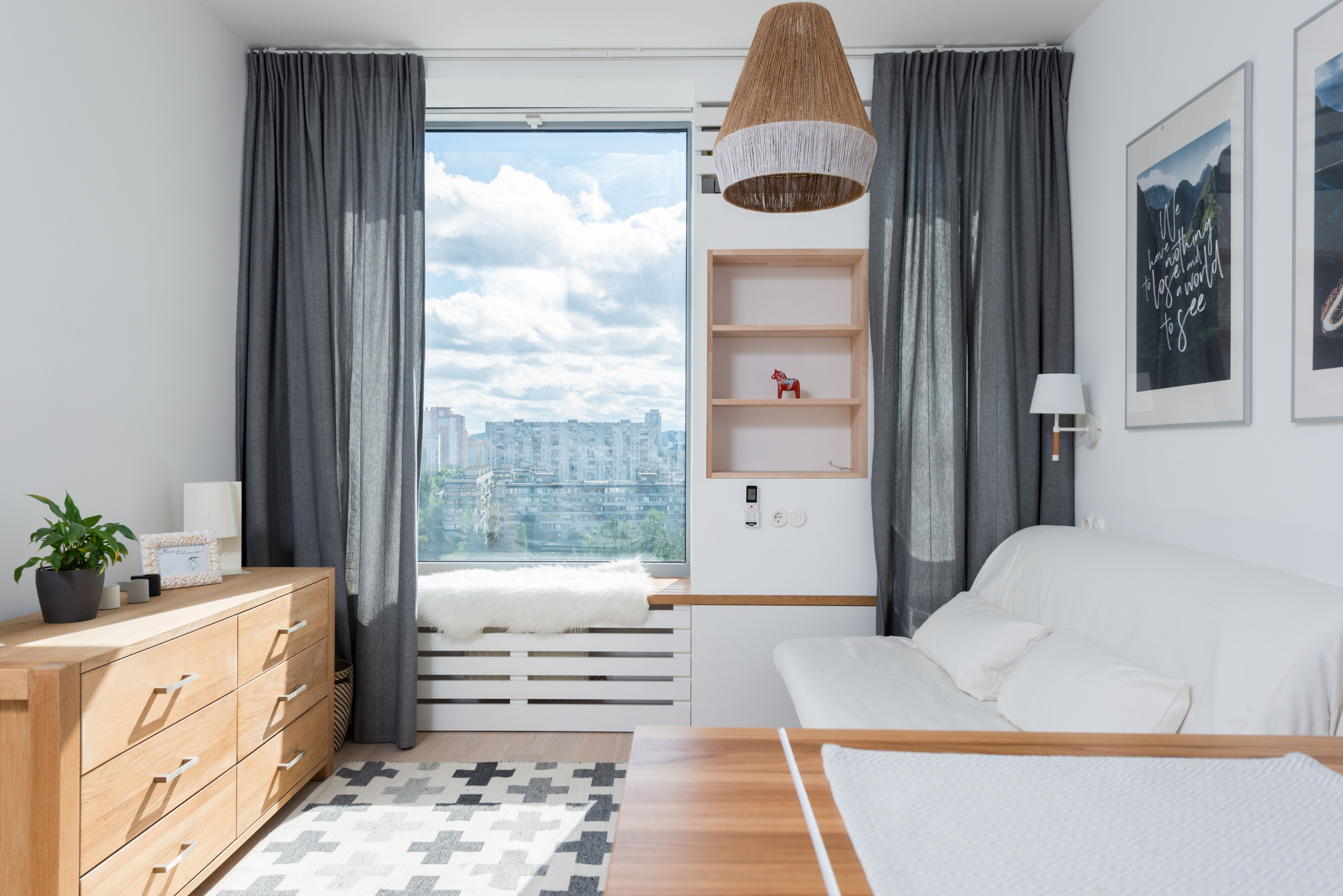
Quick Answer: Small Studio Storage Ideas That Don't Look Like Storage work by giving ordinary furniture a second job. A bed platform holds off-season clothes. A bench swallows shoes. A console hides the junk drawer. The goal is fewer visible containers, not more of them, so the room reads as finished instead of packed.
Studios punish clutter. There is no hallway closet to absorb the overflow, so every plastic bin you buy ends up as part of the decor whether you meant it to be or not. The better approach is storage that reads as furniture: pieces that hold things quietly while looking like they were chosen for the room. If you are weighing a smaller floor plan, our guide to apartment amenities in the city versus the suburbs covers which building features take pressure off your own square footage.
What Makes Storage in a Small Room Disappear
Storage in a small room disappears when the container is also something else: a seat, a table, a bed platform, a headboard. Visible bins read as clutter because the eye counts them one by one. Closed furniture-shaped storage reads as a single object, so the space looks settled rather than mid-move.
Scale matters more than cleverness here. A studio has one sightline, and anything that interrupts it gets noticed. Five matching lidded boxes stacked in a corner still look like five boxes. One bench along the same wall holds roughly the same volume and disappears into the room.
Simple Storage Solutions That Hide in Plain Sight
These are the pieces that do the most work for the least visual weight:
- A platform bed with drawers underneath, or a standard frame raised enough to clear flat bins.
- A lidded ottoman or entry bench doing double duty as seating.
- A console or sofa table with closed drawers instead of open shelves.
- A headboard with a shallow shelf behind the pillows.
- A rolling cart that parks under the counter and reads as a small island.
One caution about under-bed storage, which is where most people start. Soft goods packed tight against the floor do not breathe well. The EPA recommends keeping indoor humidity below 60 percent, ideally between 30 and 50 percent, and a sealed bin of winter sweaters is exactly the kind of spot where a damp apartment shows up first. Leave a gap for air, and skip the plastic bags.
How Do You Start Organizing Small Spaces Without Buying Bins?
Measure what you own before you buy anything to put it in. Empty one zone, sort it into keep and go, then assign the survivors to furniture you already use. Most studios lose a square foot of floor to containers bought before the sorting happened, and that floor is the thing you actually wanted back.
Context helps explain why generic advice fails in a studio. Of the 484,000 multifamily units completed nationally in 2025, the U.S. Census Bureau reports that the median unit built for rent measured 1,000 square feet, and 42 percent had one bedroom. A studio typically sits at a fraction of that median, so storage ideas written for the average new apartment assume closets and corners a one-room floor plan does not have.
Work the zones in this order, because each one frees up space for the next:
- Closet first. Whatever leaves the closet is the volume you are actually solving for.
- Kitchen second, since cabinet overflow is what usually lands on counters.
- Bed and seating last. That is where the hidden capacity lives, and you want it empty when you get there.
Creative Storage Solutions That Read as Furniture
Saving storage space is really a question of what each piece earns. A chair holds a person. A storage bench holds a person and a winter's worth of coats. When every item in a studio does two jobs, you stop needing a third category of objects whose only purpose is holding the first two.
Here is how the most common pieces compare on what they hide and what they cost you in floor space.
| Piece | What it holds | What it looks like | Renter notes |
|---|---|---|---|
| Storage bed or riser | Off-season clothes, luggage | A plain platform bed | No hardware, no wall damage |
| Lidded bench or ottoman | Coats, shoes, blankets | Seating at the door or bed | Doubles as a guest seat |
| Console with drawers | Mail, chargers, keys, tools | An entry table | Keep it shallow in a tight walkway |
| Tall wardrobe or armoire | Everything the closet rejects | A furniture piece, not a rack | Must be anchored to the wall |
| Rolling cart | Pantry and bathroom overflow | A small kitchen island | Moves out of the way on demand |
Space Saving Pieces That Earn Their Footprint
Height is the cheapest square footage in a studio, and it is the part most renters leave empty. A tall closed cabinet takes the same floor area as a low console while holding three times as much. It also stops the room from feeling like a showroom of knee-high boxes.
Tall pieces come with one non-negotiable. Under the federal STURDY Act, clothing storage units manufactured on or after September 1, 2023 must meet a mandatory stability standard and ship with anchoring hardware, and the CPSC estimates roughly 5,300 tip-over injuries a year involving those units. Secondhand dressers made before that date were never tested to it. Anchor anything tall, and put the heavy things on the bottom shelf.
Apartment Storage Solutions for Renters Who Can't Drill
Most leases allow small picture nails and little else, which rules out half the apartment storage ideas you will see online. Tension rods, over-door hooks, freestanding shelving and adhesive strips carry the load instead. Ask your leasing office what counts as normal wear before you commit, especially if you are signing a lease extension and plan to stay put.
Keep one rule in view while you arrange things. The U.S. Fire Administration advises keeping anything that can burn at least three feet from heat sources, including radiators and space heaters. In a studio, the tempting empty wall is often the one with the radiator on it. Leave that gap, and keep the path to the door clear.
Frequently Asked Questions
1. What is the best hidden storage for a studio apartment?
A storage bed does the most, because it uses floor area you have already paid for and hides the bulkiest items you own. A lidded bench comes second. Both hold real volume without adding a single object that looks like a container.
2. How do I store things in a studio without it looking cluttered?
Cut the number of visible containers and raise their quality. Three good creative storage ideas beat ten matching bins. Keep surfaces clear, choose closed storage over open shelving, and match finishes so separate pieces read as one intentional set rather than an accumulation.
3. Where can I add storage in a small room without drilling?
Plenty of options work with no hardware at all:
- Bed risers with flat rolling bins underneath
- Tension rods inside the closet for a second hanging tier
- Over-the-door racks on the closet and bathroom doors
- Freestanding shelving that stands on its own weight
- A rolling cart tucked beside the fridge or under a counter
4. Is under-bed storage a bad idea?
It is the best space in most studios, with one condition. Do not pack it airtight. Leave a finger of clearance between bins and the floor, keep fabric out of sealed plastic bags, and pull things out twice a year to check for damp, particularly along exterior walls.
5. Do I need to anchor storage furniture in a rental?
Yes for anything tall, and yes even when you rent. Anchoring kits use two small screws and patch easily at move-out. Tell your leasing office you are installing one. Most treat anchor holes as ordinary wear rather than damage, but ask before you make the holes.
Conclusion
The best Small Studio Storage Ideas That Don't Look Like Storage are not really storage products at all. They are furniture choices made with a second question attached: what does this piece hold? Answer that for the bed, the seating and the entry, and the bins stop multiplying. Whether you are setting up your first apartment off campus or downsizing on purpose, a studio that hides its own clutter feels considerably larger than its square footage suggests.